
cheating twink death
condamné(e) à être polysémique

Burroughs’s idea of the forties was “What if truth broke out? What if everybody started talking frankly.”
— Alan Ginsberg, The Best Minds of My Generation: A Literary History of the Beats
Sigmund Freud writing to Sándor Ferenczi am achten Juni neunzehnhundertdreizehn:
Zum Semitismus: Es gebe gewiss große Unterschiede vom arischen Geist. Wir überzeugen uns alle Tage davon. Daher werde es sicherlich hier und dort verschiedene Weltanschauungen und Kunst geben. Besondere arische oder jüdische Wissenschaft dürfe es aber nicht geben. Diese Resultate müssten identische sein und nur die Darstellung könnte variieren. Gingen diese Differenzen in die Auffassung objektiver Verhältnisse in der Wissenschaft, so sei etwas nicht in Ordnung.“
Ironically, a soi-disant commitment to objektiver Verhältnisse in der Wissenschaft led to the defenestration of both Freud and Jung from the psychological establishment for being shoddy scientists.
In the introduction to his Esquisse d’une théorie des émotions (Éditions Hermann, Paris, 1938), entitled «Psychologie, phénoménologie et psychologie phénoménologique», SARTRE writes (traduit en franglais par Marie-Jeanne de Rothschild von Eyre — les italiques sont de SARTRE):
Psychology pretends to be a positivist discipline, that is to say it seeks to be based on experience alone. Certainly, we are no longer in the time of the associationists; contemporary psychologists do not purport to interrogate or to interpret. They wish to be faced with their object [of study] like the physician faces his. Furthermore, it is necessary to limit this concept of experience, when one talks about contemporary psychology, because there could be, in sum, a crowd of diverse experiences and, for example, one may have to decide if there exists or not an experience of essences or of values or something like a religious experience. The psychologist only relies on two well-defined types of experience, that presented to us by la perception spatio-temporelle des corps organisés, et cette connaissance intuitive de nous-mêmes qu’on nomme expérience réflexive. If psychologists engage in debates about methods, it is almost uniquely about the following problems: are these two types of information complementary? Should one be subordinated to the other? Should one or the other be resolutely rejected? But these psychologists agree on an essential principle: their inquiry has to proceed from the facts. If we ask ourselves what is a fact, we see that it is defined by that which one encounters in the course of a study, and which is always presented as an unexpected enrichment and a novelty compared to previous facts. One should therefore not count on facts to organise themselves into une totalité synthétique qui livererait d’elle-même sa signification. Put differently, if we call anthropology a discipline that aims to define the essence of man and la condition humaine, psychology — even the psychology of man — is not and will never be an anthropology. It does not seek to define and limit a priori its object of study. The notion of man that it accepts is totally empirical : il y a par le monde un certain nombre de créatures qui offrent à l’expérience des caractères analogues. Other sciences — sociology, physiology, etc. — have taught us that there are certain objective links between these creatures. The psychologist needs nothing more than to provisionally accept to limit, with prudence and under the auspices of a working hypothesis, his research to this group of creatures. Information about these creatures is more readily available since they live in society, are in possession of language and leave witness of their existence. Mais le psychologue ne s’engage point : il ignore si la notion d’homme n’est pas arbitraire. It could be trop vaste : nothing suggests that the primitive Australian can be put in the same psychological class as the American worker of 1939. It could be trop étroite: nothing suggests that an abyss separates the higher apes from a human creature. In any case the psychologist defends himself rigorously from considering the men around him ses semblables. This idea of similitude, à partir de quoi l’on pourrait peut-être construire une anthropologie, lui parait dérisoire et dangereuse. He’d readily admit, with the aforementioned caveats attached, that he is a man, that is to say he forms part of the provisionally isolated class. But he would consider that this caractère d’homme ought to be conferred a posteriori and that he cannot, as a member of this class, be the privileged object of study, except for la commodité des expériences. Il apprendra donc des autres qu’il est homme est sa nature d’homme ne lui sera pas révélée de façon particulière sous le prétexte qu’il est lui-même ce qu’il étudie. Introspection yields here, as in the case of l’expérimentation «objective», only facts. If later a rigorous concept of homme is needed — and even that is doubtful— this concept cannot be envisaged other than as couronnement d’une science faite, c’est à dire qu’il est renvoyé à l’infini. Even then it would only be une hyptohèse unificatrice inventée pour coordonner et hiérarchiser la collection infinie des faits mis en lumière. This is to say that l’idée de l’homme, if ever it were to take on un sens positif, it would only be a conjecture aiming to establish connections between disparate materials and will take its vraisemblance only from its success.
PIERCE [sic] définissait l’hypothèse: la somme des résultats expérimentaux qu’elle permet de prévoir. So l’idée d’homme can only be the sum of the established facts that it permits to unify. If certain psychologists use une certaine conception de l’homme avant que cette synthèse ultime ne fût possible, ce ne pourrait être qu’à titre rigoureusement personnel et comme fil conducteur kantien and the first duty of these psychologists should be to never forget that il s’agit d’un concept régulateur.
To be honest, I haven’t made much of an effort to understand Sartre’s own theory of emotions, but I think his introduction is a good illustration of the inherent limitations of such theorising. SARTRE expresses a recognisable reticence to be analysed or studied by an “expert” in ψυχή. But how do we avoid scientism without wallowing in woo? I’m no anthropologist, but I doubt SARTRE’s definition of that field of inquiry (do people still say «discipline»?) is universally accepted. En outre, SARTRE can’t help but revert to religious language when talking of les créatures humaines. It would be much more accurate to call ourselves «les développements humains». The fact that we don’t suggests something important about the intrinsic conservatism of language (of the living).
Scrivere nella lingua del nemico, ma corromperla

The rainbow used to be the symbol of the Abusive Father, before philosophy unweaved it (as lamented by Keats, as critiqued by Dawkins). The symbol was rewoven into different narratives, tales first about the luck of the Irish and then about the technicolour damnation of the poetsgays. Personally I’ve never felt much affinity with the rainbow qua symbol of gay liberation. I was never into the whole “bring your (w)hole self to work” thing. I prefer to keep my Bermudan option dealers separate from my Brazilian boy toys. (Mob accountants and Jesuits were the original post-modernists).
Nevertheless, in the spirit of no negation I choose to view the symbology of the xviii O.G. O.G. Pride flag as synchronous with my sense that I should start L’ALBVM ZVTIQVE with la femme (IYKYK), so with a nod towards the illustrious example of my fellow créole Doris Lessing (criminally underrated around these parts), I decided to facilitate the birth not of “a novel” , but rather a queer sort of collaborative graphic novel — akin to what the ancients called a «magazine», un objet d’art populaire that they used to sell in establishments called «newsagents» (now vape-and-protein shops, soon to be soma dispensaries cum techno chillout lounges).1
The dark irony of the backwards prioritisation of sex over life was lost when the octocolour was truncated to the more familiar hexacolour, but the colour pink made a comeback (with the colours white and powder blue) to form the thin end of the chevron on the controversial “progress” flag that was all the rage in prominent outposts of the G.A.E. a few years ago.
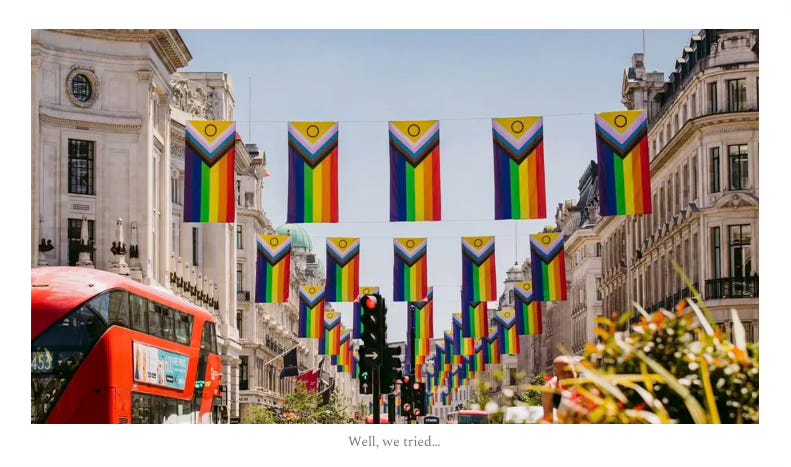
I used to get (more) upset about such things, but K taught me to recognise that the roots of the delusions that cause an adult human being to proudly wave around a flag of whatever stripe or colour runs very deep indeed:2
We human beings are what we have been for millions of years- colossally greedy, envious, aggressive, jealous, anxious and despairing, with occasional flashes of joy and affection. We are a strange mixture of hate, fear and gentleness; we are both violence and peace. There has been outward progress from the bullock cart to the jet plane but psychologically the individual has not changed at all, and the structure of society throughout the world has been created by individuals. The outward social structure is the result of the inward psychological structure of our human relationships, for the individual is the result of the total experience, knowledge and conduct of man. Each one of us is the storehouse of all the past. The individual is the human who is all mankind. The whole history of man is written in ourselves.
Do observe what is actually taking place within yourself and outside yourself in the competitive culture in which you live with its desire for power, position, prestige, name, success and all the rest of it — observe the achievements of which you are so proud, this whole field you call living in which there is conflict in every form of relationship, breeding hatred antagonism, brutality and endless wars. This field, this life, is all we know, and being unable to understand the enormous battle of existence we are naturally afraid of it and find escape from it in all sorts of subtle ways. And we are frightened also of the unknown — frightened of death, frightened of what lies beyond tomorrow. So we are afraid of the known and afraid of the unknown. That is our daily life and in that there is no hope, and therefore every form of philosophy, every form of theological concept, is merely an escape from the actual reality of what is.
All outward forms of change brought about by wars, revolutions, reformations, laws and ideologies have failed completely to change the basic nature of man and therefore of society. As human beings living in this monstrously ugly world, let us ask ourselves, can this society, based on competition, brutality and fear, come to an end? Not as an intellectual conception, not as a hope, but as an actual fact, so that the mind is made fresh, new and innocent and can bring about a different world altogether? It can only happen, I think, if each one of us recognises the central fact that we, as individuals, as human beings, in whatever part of the world we happen to live or whatever culture we happen to the world belong to, are totally responsible for the whole state of the world.
We are each one of us responsible for every war because of the aggressiveness of our own lives, because of our nationalism, our selfishness, our gods, our prejudices, our ideals, all of which divide us. And only when we realise, not intellectually but actually, as actually as we would recognise that we are hungry or in pain, that you and I are responsible for all this existing chaos, for all the misery throughout the entire world because we have contributed to it in our daily lives and are part of this monstrous society with its wars, divisions, its ugliness, brutality and greed - only then will we act.
The machine demons tell me the word comes from مخزن (makhzan) — storehouse, warehouse. The English publisher Edward Cave appropriated the word for The Gentleman’s Magazine, first published in 1731.
KRISHNAMURTHI, J. Freedom from the Known (1969)
Um, not Joseph's coat of many colors?