
Gay panic!
Thoughts on Inversion: Gay Life after the Homosexual (2025)

What crisis?
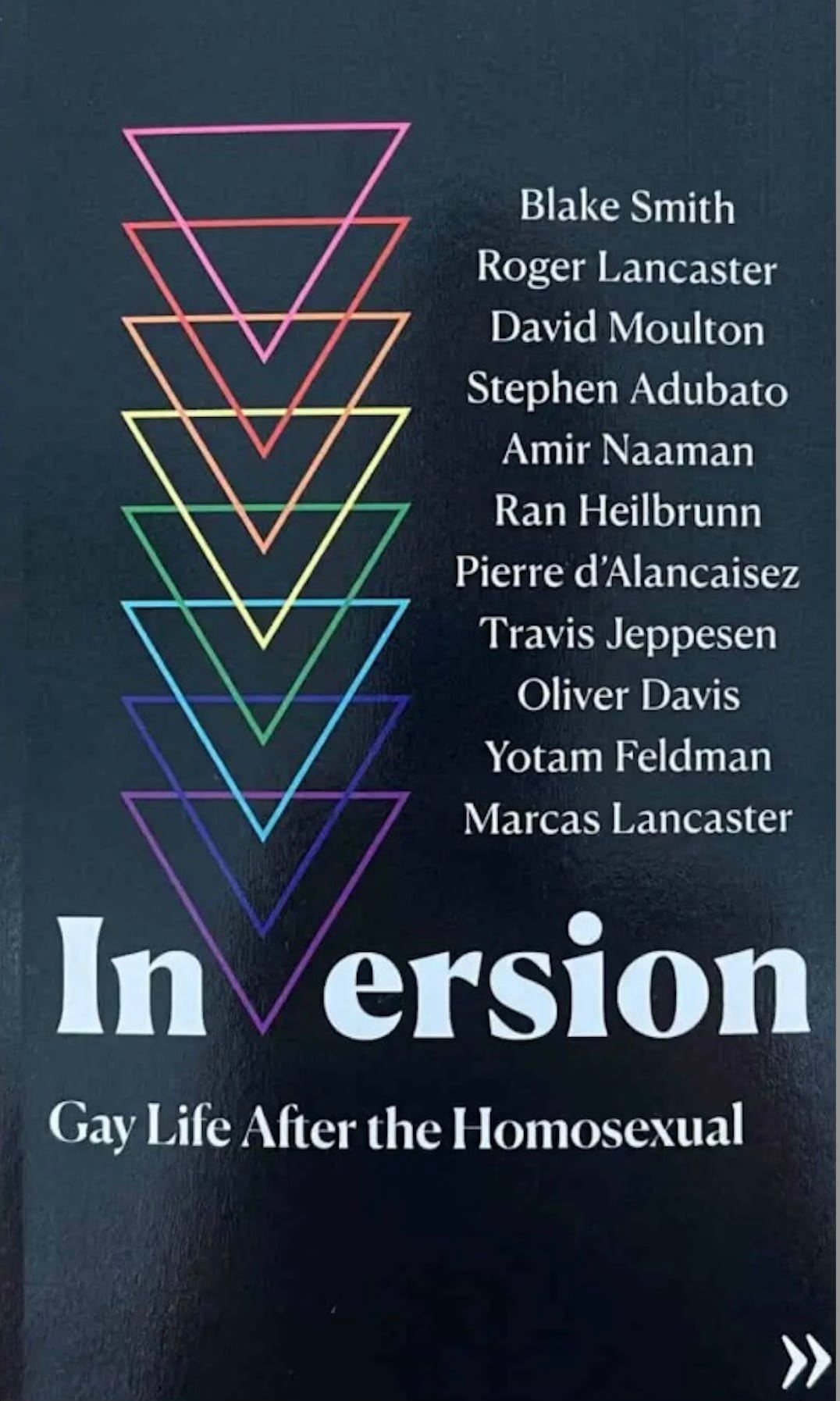
I decided to read Inversion: Gay Life after the Homosexual (2025), a collection of essays edited by Pierre d’Alancaisez and Amir Naaman, after getting annoyed at Freddie De Boer’s post “I Miss When Homoeroticism Was Erotic”, in which he takes the overrepresentation of queers on the extreme ends of the asexual/hypersexual spectrum as evidence that the only interactions that gays have these days is either chastely queening out over celebrity memes or senselessly fucking each other en masse under conditions that are part factory farm part satanic ritual.
Since everything seems to be in crisis these days, from higher education to democracy, from liberalism to humanism, from international law to the natural environment, you can be forgiven for not noticing the “crisis of homosexuality”, which the editors assure us is totally a real thing:
Loath to miss out on the attention, homosexuality has added itself to this ever-growing list, too. Yet while Western societies have only recently come to contend with a general ‘crisis of meaning,’ gays have failed to resolve theirs for decades. This is evident from how many of this book’s contributors have chosen to situate gayness historically, having, in more than one instance, to look to antiquity for better narratives than those associated with the homosexual today.
Gays — always ahead of our time! Note how “homosexuality” is described as something that adds itself to the agenda, rather than something that has been argued into crisis in order to justify a collection of essays on the topic:
Homosexuality is in crisis because it has found itself incapable of debating its position in the culture wars, regardless of whether their particular grievances are bogus or politically salient. Homosexuality is in crisis because, while there has hardly been a better time to be openly gay, many gay men have noticed the G of ‘gay’ going spare in the ever-expanding alphabet of 2SLGBTQIA+ concerns. Homosexuality is in crisis because, having turned all art and culture gay, it has lost the friction that once sustained it.
Again the Blakean personification of homosexuality as something that is capable or not of debating its position. And what does the G going spare actually involve beyond the job market for cis white gay studies drying up? One gets the feeling that this project was conceived during the previous regime, when queers were still in ascendance and gays felt the need to mount a rear-guard defence. Ran Heilbrunn’s stunning and brave call to “Abolish Queer Theory!” rings rather hollow after the queers have all but abolished themselves, and with Christopher F. Rufo more than happy to finish the job. [ETA: I admit in the comments to being unfair to Heilbrunn and too hastily dismissing the continued tyranny of queer theory in academia, including outside the US.] I have seen little evidence to suggest that the Gs have it particularly tough in Trump’s America, with the Supreme Court declining to reconsider its 2015 decision on same-sex marriage.
Granted, if the political rights of gays are for the moment secure, this doesn't mean the destinies of our gay souls are. Take sex for example, it appears that younger gays are having the wrong kind and not enough of it (unless they are lying and having too much):
Some of these gay men are having sex. But this sex, fueled by the now ubiquitous PrEP and increasingly commonplace DoxyPEP and gonorrhea vaccinations, is qualitatively different from the sex of recent generations. A new feeling of pharmacological invincibility temporarily became gay men’s superpower during the COVID-19 pandemic — the quarantine gay ‘chill’ orgy deserving its own version of The Decameron — but it waned with the arrival of the stigmata-producing Mpox in 2022, with even the infection’s original name ‘monkeypox’ deemed too offensive to the fragile egos of the ‘men who have sex with men’ most affected by it. Gay sex may also be quantitatively different because younger generations are having a lot less of it altogether — at least according to surveys — preferring instead to ‘perform’ it for their phone cameras. Gay sex, therefore, might be becoming a thing that we look at on a small screen rather than do, although whether the polling data matches the use patterns of sex-express apps such as Sniffies is debatable.
In addition to obtaining civil rights and legal protection against discrimination, a key objective of gay activism was destigmatising gay sex and relationships. Before we start dragging each others for being common garden hoes, can we at least raise a glass of Prosecco to celebrate our victories?
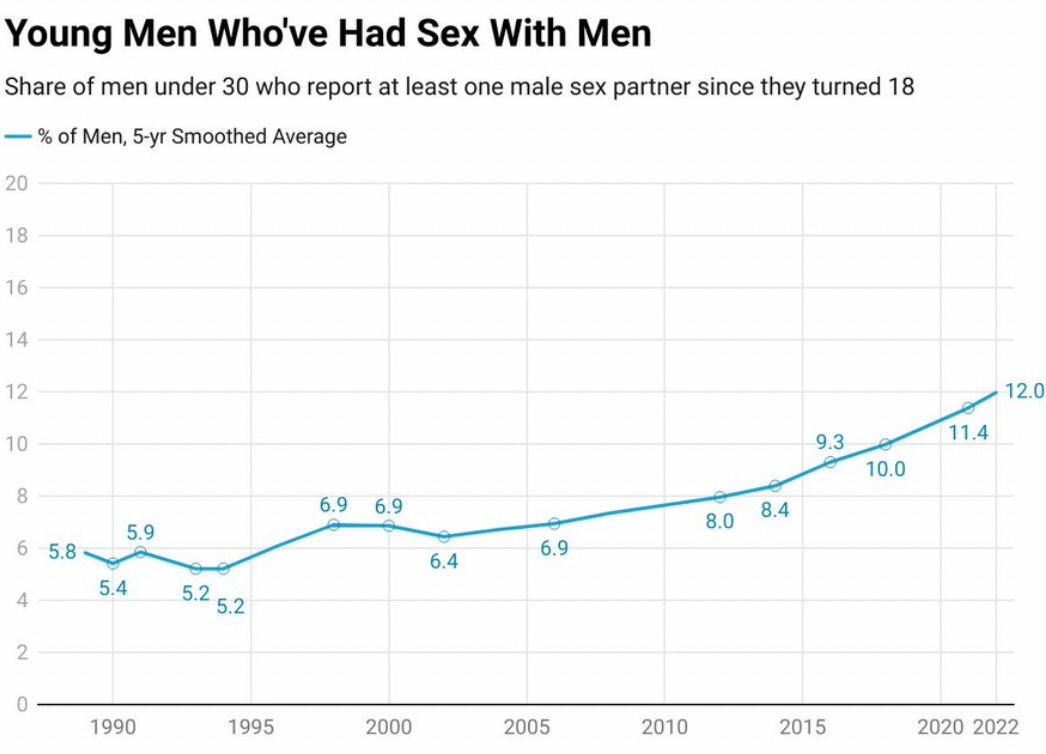
We still have a long way to go, but it doesn’t look to me like it’s homosexuality per se that is in crisis.
Historicise me like one of your French girls
According to editors, the fact that gayness is generally not biologically transmitted presents a challenge for “gay history”:
Gay men, in other words, can’t teach their grandsons gay history, and the grandsons must invent it from naught. The corruption of gay history might, therefore, be one of its historical constants. The historical blind spots this inevitably creates become the space of ideology and propaganda.
For the record, my straight grandfather didn’t teach me much straight history either. It is also not obvious to me why we should analogise gay history to the history of the English or the Poles rather than to the history of tarot or opera. Attempts to fill in historical blindspots are always welcome, but the effort in Inversion to historicise the development of homosexual/gay/queer identities suffers from the fact that many of the essays cover the same narrow ground of post-70s American academia. Since Blake Smith is writing a book on Michael Denneny and the development of the modern American gay identity in parallel with the modern American Jewish identity, it’s understandable why his essay “For the Love of the Gay World” would focus on this milieu, but it is less obvious why the rest of us should pay special attention to this particular gay world, rather than say the world of Thai drag queens or revellers in Rio.
Smith writes:
Throughout history, and in many societies today, this is how sex between ‘men’ works: by making one participant a non-man, placing him in what is understood to be an inferior social role deprived of male status and privilege. The distinction between this sort of sex and truly homo sex (that is, sex between men understood to be, insofar as they are men, the same) is a crucial one.
I agree. I am less convinced of the significance of the move from homosexual to gay. The former term might have originated in a biomedical context, but when taken at face value, it is pretty self-explanatory. The term “gay” doesn’t add much to the basic fact pattern, except for a bit of wishful thinking, exemplified by the slogan “gay is good”. Repeat it enough times and you’ll come to believe it.
I have argued for what might be termed gay Philistinism. Nassim Nicholas Taleb observes that businessmen rarely turn to professors from the Harvard Business School for business advice. Likewise, I don’t need someone with a PhD in High Faggotry to teach my how to suck dick, spill the tea or have a gay meltdown about what I’m going the wear to the party. It’s not that I’m against higher learning, but if you are going to go through all that effort, you might as well learn about something other than being gay.
Won’t someone think of the cumdump?
In “Twilights of Homosexuality”, Yotam Feldman laments that “homosexuality lost its power to scandalise”, but judging by many of the contributions, gays have retained the ability to scandalise each other. So scandalised is d’Alancaisez in his essay “Freedom of Disassociation” that he can hardly think straight:
The keen mass adoption of technologies like PrEP by gay men in the 2010s suggests that they are more than willing to renege on their mutual duties (of sexual care, for example) in affirmation of their independence from the community.
Pre-Exposure Prophylaxis is widely promoted by sexual health authorities as an alternative to condoms for preventing the transmission of HIV. It is unclear why its adoption represents a reneging on mutual duties of sexual care, or indeed what such duties might entail. d’Alancaisez presents to us as embodiment of the pornsick homosexual id the figure of the cumdump: face down, ass up for any takers, voluntarily turning himself into nothing but an orifice, a human fleshlight:
We can debate whether the relocation of anonymous gay sex from parks and laybys to smartphones and hotel rooms is meaningful. Yet it is the complete evacuation of sociality from cumdump encounters, in contrast to ‘traditional’ cruising or even the entangled embodiment of sex club darkrooms, that is remarkable.
I happen to agree that a certain erotic frisson gets lost when sex is reduced to a visit to the neighbourhood depository. I have never met someone off Sniffies (I only had a brief look around, for research purposes), so I do not consider myself as representing the homosexual avant-garde or anything. I write about my relatively tame sexual adventurism not to promote it as some radical new path to spiritual enlightenment or to indulge an exhibitionist kink (not that there’s anything wrong with that), but merely to observe the ways in which my experience of the territory does not match the sharp contours on the maps on offer.
I believe that d’Alancaisez’s concern for the cumdump is genuine, as is mine for the men who market themselves as pigs or slaves or human toilets. Is it simply the case that the kink fairy decided to bless them with a humilation fetish, or is there something more going on?1 If these men were my friends, I would have asked them. But they are not my friends and they are not asking for my sympathy, they are asking for me to piss on them. Afterwards perhaps we can talk. It would indeed be helpful to have a moral vocabulary to describe such arrangements as… suboptimal?
For better or worse, Grindr is the biggest 24/7 gay club in just about any city on the planet (even in places where half the profiles belong to cops and other extortionists). So you get all sorts: not only daddies, twinks, jocks, bears and otters, but soft tops and bossy bottoms, brats and tamers, bulls, studs, pups, rope bunnies, silver foxes, gaymers, bators and gooners (there’s a difference), MtF and FtM, the barely legal and the barely compos mentis. It’s a veritable menagerie! (For an artistic representation, I refer the reader to the bottom-right corner of The Garden of Earthly Delights by Hieronymus Bosch). Grindr is like crack for autistic sluts. The first decade or so as a practicing homosexual, the only cruising I did was the virtual kind.
A few years ago I made the first of only a handful of visits to an actual gay sauna. The mental images I had of such establishments had been garnered from literature, pornography and hearsay about creepy old men unable to procure sexual attention in any other way. I considered it my epistemological duty to check it out for myself. The sauna I visited was in Amsterdam, during daytime. It was more like a regular sauna than you might expect. There was a locker room, showers, steam room, dry sauna, jacuzzi and lounge area. And a maze of recesses and cubicles in different shades of darkness, of course. I enjoyed the ambience, even though I didn’t have sex with anyone. In fact, I found it exhilarating to politely decline the advances made towards me. My rejections were accepted with grace. The age range was more mixed than I expected. There were older men with bodies that I didn’t find attractive. But I didn’t find them creepy. In their nakedness I saw a humanity. Like their younger and lither counterparts, they were taking a break from the world of reasons and persons, enjoying the simpler pleasures of life: a relaxing bubble bath, a cathartic sweat and a look, if nothing more, at fresh young flesh.
A few years later I went back to the same sauna, again during daytime. This time I did engage in some sexual activity. Whilst in the steam room, an older gentleman encouraged me to fellate an attractive young man who had come to sit next to me. Although I wasn’t attracted to the older man, I would be lying if I said that I didn’t derive additional pleasure from the knowledge that he was deriving pleasure from my erotic performance. “Mooi, jonge,” he told me. It was a memorable experience. Was it meaningful? It felt more meaningful than most of the contemporary art pieces that I had attempted to engage with at the Stedelijke Museum. Perhaps my sense of meaning is intrinsically disordered. That is certainly the traditional position.
Critics of causal sex often conflate depersonalisation with dehumanisation. I’m not really into guys on the DL, so my hookups are generally not anonymous, although sometime we’ll realise post-coitally that we forgot to exchange names beforehand, simply because it didn’t seem relevant at the time. Cumdumps aside, advertising yourself on Grindr does not equate to, as de Boer puts it “figuratively turning your red light on to everyone and everything”. This description applies to actual sex workers who are indeed less likely to discriminate since they provide a service in exchange for a monetary reward. I don’t go on Grindr to sleep with just anyone. That wouldn’t be a very gratifying game.2
Category is… death by Aristotle
Several contributors seem disappointed by how homosexuality is nowadays treated as no big deal in liberal societies. Feldman:
Clearly, if we wish to understand homosexuality’s true significance, we need to go deeper, beyond its current liberal form, but also beyond its mere negation by ‘traditionalist’ philosophy. We need to dive into the realms of perversion. […]
For better and worse, sexual relations between men are considerably less regulated than straight sex. Not least because gay sex lies, outside the (natural, societal) law. Similarly, there are no codes of conduct for men who would like to have intercourse with farm animals. By trying to regulate elicit activity you run the risk of tacitly condoning it.
In “The Deception of Orientation” Stephen Adubato praises the “shockingly sober and measured” 1986 letter by Cardinal Ratzinger affirming the Church’s condemnation of homosexuality. Adubato describes himself as “a monotheist, a Christian, a Roman Catholic, and thus, a metaphysical realist and a moral traditionalist” and is very attached to Thomists ideas of natural law (“we should all be able to recognize the nature of a gun: a technology designed to injure and/or kill a living being.”) Adubato thereby insists that “homosexuality is not ontologically the same as heterosexuality”, and that “[e]ven non-coital (oral) gay sex is not the same as its straight equivalent”, a position not shared by the Catholic intellectual G.E.M. Anscombe, who did not recognise moral distinctions between different types of non-procreative sex, straight or gay.
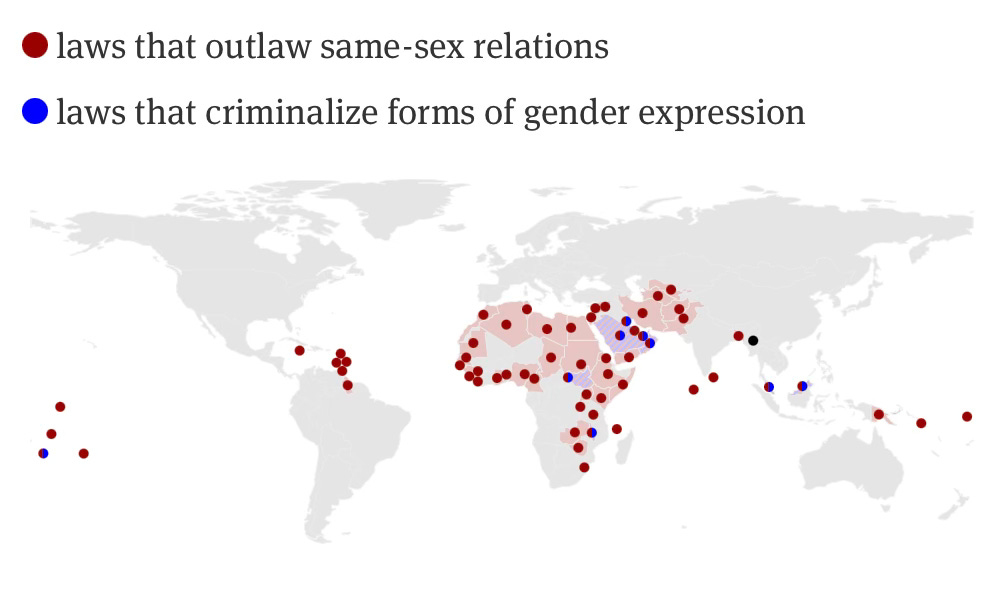
Watching a debate between a fundamentalist preacher and trans woman in Uganda, where the Anti-Homosexual Act was signed into law in 2023, prescribing life imprisonment for sex between two people of the same biological sex and the death penalty for “aggravated homosexuality”, Adubato is more impressed by the rhetoric of the former than the latter. He also quotes Pope Francis’s warnings about “the ‘ideological colonization’ of gender theorists in developing countries in Africa and South America”. Such fears have been exploited by China and Russia to foment anti-Western sentiment and intrench anti-gay laws and prejudices seeded by previous waves of “ideological colonization”. Those who miss the thrill of copulating under threat of persecution have several options to choose from:
Replace the gay away
“The Great Gay Replacement” is an interesting attempt by Oliver Davis to reconcile the homophilia and xenophobia of the problematic pouffe Renaud Camus. But I was unconvinced by the suggestion that Camus’s warnings about the replacement of le peuple français can be read as an analogy for how the focus of progressive activism has shifted away from gay men:
Are we, as gay men — or as other constituent members of the queer nation — allowing ourselves to be replaced, consigned to the dustbin of history? Certainly, even in the privileged parts of the privileged world, we move more meekly than we did in the years of gay liberation. For some gay men half a century ago, incredible though this may seem today, the envelope of solidarity had already been pushed to the outer limits when they were grouped with lesbians and later bisexuals under the queer umbrella. Many gay men today, evidently, albeit often quietly, feel even less affinity with still later arrivals — trans people — and deeply resent the often hectoring way resistance to being replaced by this new focus of attention and care is dismissed.
I’d argue that the projection goes the other way: fears of gay neglect by the LGBTQ+ movement (or LGBTQ+ industry, as David Moulton calls it in “Towards a Gay Art of Suffering”) covers up a more fundamental fear that the presumption of individual liberty that made the creation of “gay worlds” possible in the first place is not shared by all cultures across the globe. Even so-called heritage Americans and Englishmen seem to have grown iffy on the principle.
The overall tone of Inversion is not one of alarm but ennui. I thirsted for a dash of… diversity maybe? Despite hailing from a variety of nations, the perspectives in this volume are about diverse as the gays at The Two Brewers in Clapham.3 The volume would have benefited greatly from a view on gay culture from a queer theorist like Anna Khachiyan or John Pistelli. Khachiyan’s sensibility owes much to Paglia (cited liberally by both d’Alancaisez and Adubato), even if she expands on her ideas in ways many find distasteful. Pistelli has demonstrated in his fiction and criticism that the soul of the artist is omnigendered and pansexual, only dimly connected to particular hankerings of the flesh.4 It would be silly to leave the last word on what it means to be gay to a straight man or woman, but I see no need to dismiss their perspectives out of hand.
Burning my gay card
“Gay” is still the most straightforward description of my proclivities, but I won’t be offended if you would rather call me an invert, a Uranist or a butt pirate. Recent developments bring into question the wisdom of basing the idea of a collective gay identity on that of modern American Jews, whom Weil would have denounced as a people who worship nothing but themselves. The desire to transcend the fragile individual ego is understandable, but I doubt any attempt to construct a collective ego will satisfy the restless heart. To paraphrase Paglia by means of the online right, I didn’t slag off Jehovah to get fisted by Foucault!
I was pleased to see my literary daddy Jean Genet get some attention, although more for his fetishisation of Palestinian freedom fighters than for his contributions to literature and philosophy. If we are interested in how existence and essence interact in the context of homosexuality, perhaps we should revisit Jean-Paul Sartre’s Saint Genet (1952). Even if he was wrong about Genet and/or homosexuality, we might learn something. We like to see ourselves as the heirs of the existentialists, but much of post-70s political and intellectual energy has gone into finding ways to avoid the crushing responsibility of individual freedom. We have not thereby created a society of collective responsibility, but rather seem to have settled for collective irresponsibility, fighting id with id.
In Degrees of Freedom, A.S. Byatt reads Murdoch’s early fiction as an extended conversation with Sartre on the topic of freedom, started in the book Sartre: Romantic Rationalist (1953):
The Marxists revile Sartre because he describes man as a fundamentally non-social, non-historical individual. But what Sartre wishes to assert is precisely that the individual has an absolute importance and is not to be swallowed up in a historical calculation. Sartre’s man is depicted in the moment-to-moment flux of his thoughts and moods, where no consistent pattern either of purposeful activity or of social condition can easily be discerned; at this level freedom seems indeed like randomness, the freedom of indifference.
In a previous attempt to rationalise my slutty behaviour, I quoted from Murdoch’s “The Moral Decision about Homosexuality”, written at a time when Britain was debating abolishing its anti-sodomy laws, which it eventually did in 1967:
In the end it is a simple matter of human rights. One has a right to choose to be celibate: though even this right is sometimes challenged nowadays and the celibate person looked on with suspicion or contempt. One has also a right to choose to be homosexual, or to accept the fact that one is, and to be left alone. Human beings differ vastly, and being heterosexually married is not the only ‘proper’ or ‘rich’ or ‘rewarding’ way of life. The choice to be homosexual is a hazardous choice, for the reasons I suggested; but the choice to be celibate is a hazardous choice, and the choice to marry is a very hazardous choice. It is not easy for human beings to achieve a completely contented and orderly existence whatever they do; and responsibility for others and service to the community can be found on all these paths.
But Murdoch’a greatest contribution to gay acceptance was through her fiction, as Peter J. Conradi observes in the Afterword to Iris Murdoch: A life:
She helped pioneer a writing about homosexuality as merely one part of human life. It is typical of her quiet subversiveness that only the gay partnership survives in A Fairly Honourable Defeat - the heterosexual relationships all fall apart under the strain of the plot. Few women novelists write with as much conviction from the point of view of male homosexuals, and no other woman writer so well impersonates men.
I’d prefer to live in Dame Iris’s gay world.
One is not born a cumdump, but becomes one.
Matt Yglesias has made a centrist argument for banning online sports betting, saying that some harm may be prevented if people are forced to go to a physical shop to place a bet. Likewise, if a man wanted to plant his face in a stranger’s crotch, should he be made to first go out and listen to I will survive while nursing an overpriced gin and tonic?
Note to non-gay non-British readers: not very diverse.
John’s recent comments on “autoandrophilia” is not without relevance to men of the homosexual persuasion.
Great review. You show very well how these reflections on gay life are an essential component of a wider cultural and political shift. I find some of the anti-medical views, like the comments on prEP that you note, fairly alarming. All too easy to see how the suspicion of risk-free sexual pleasure plays out in other domains.
I cannot really fathom why anyone would choose to consume Freddie deBoer's thoughts on gay sex tbh