
gone girl
la femme dite <<straight>> existe-elle?

the temptation was strong to write this all in lower case (again),1 but I resisted
for the record, i don’t enjoy writing negative reviews
write better books please
xoxo
where have all the good straight (wo)men gone?
The last Jewish white male author. The last cis white gay. The last two lesbians. The last transexual. The last Afrikaner. If it’s a human breed you can bet it is dying: a species endangered if not actively threatened with genocide. In response to this chorus of vanishing voices, the straight female Phoebe Maltz Bovy says: me too, me and my kind are also disappearing (or what’s almost as bad: going out of fashion).2
They say il n’y a pas d’hors-texte de hors-texte.

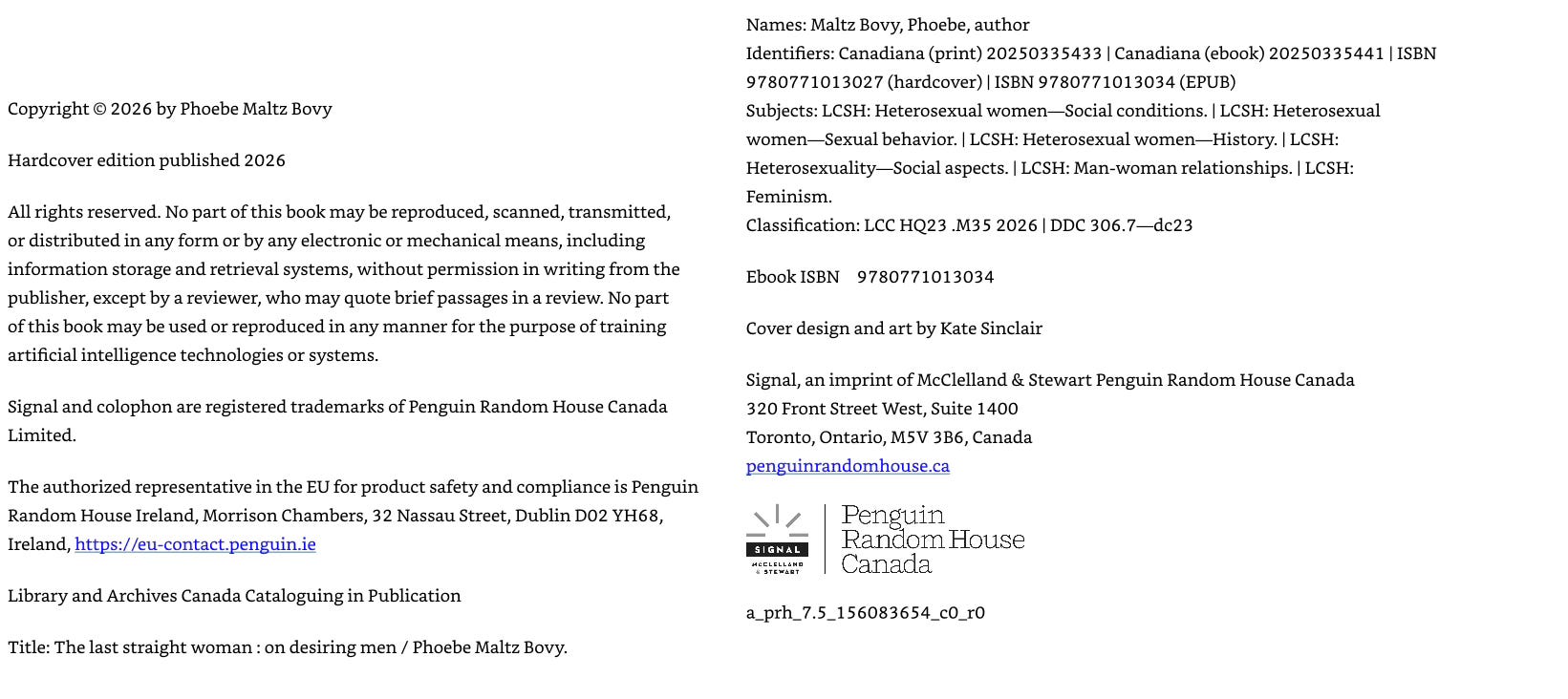
un sujet grave
Judging by falling birthrates and my Substack feed, heteropessism is a serious problem, but rather than offering new insights, Bovy has chosen to simply rehash some of the stupidest things that celebrities and Internet randos have said (emphasis in original):
I’m not here to say that male and female sexuality are identical, or would manifest themselves as such in a sexism-free Utopia. Depending how you measure, Team Women are like so has observable facts on its side. Women are on average smaller and physically weaker than men, and we’re the ones who get pregnant and have babies. Even a trans-inclusive definition isn’t going to throw off those averages. Men will swipe yes I will sleep with that woman pretty much indiscriminately on apps. There have always been rather more men prepared to pay to have sex with women than vice versa. People who have taken testosterone—cis and trans alike—report sexual desires of an intensity that my dainty lady-brain could not fathom.
But is female desire really that different from male? If women aren’t sexual, what can explain all the efforts, across different societies, to curtail female sexuality? Why execute adulteresses or excise clitorises if not to keep us in check? (The existence of slut-shaming presupposes the existence of slut.) If sex is something women at most tolerate, what can explain the immense popularity of romance novels, which women read not as marital instruction manuals but as porn? If sex is just about placating husbands, why are some women the higher-libido partner in a libido-mismatched straight relationship? And if female sexuality is inherently fluid, how do we explain all the lesbians who have tried and failed at straightness, not to mention the ranks of straight women who have attempted in vain to expand their horizons?
Nobody’s saying straight women aren’t real, Phoebe, stop making things up. Except they are! When Emily Ratajkowski told Harper’s Bazaar, “I don’t really believe in straight people,” this read not as some bizarre off-the-cuff utterance of an avant-garde eccentric, but as a celebrity aligning herself with the zeitgeist. There are several separate theories that amount to a belief in the falseness of straight womanhood. I present each—along with my doubts—below.
Celebrities say the darnest things! There is no shortage of wacky statements that people seem to sincerely believe. I prefer to talk about vibes rather than the zetigeist, but OK, let’s take the statement “I don’t really believe in straight people by Emrata (whose existence I’m only aware of via the Red Scare podcast and a video ER did with Andrea Long Chu) seriously. Does Bovy help us trace the deep roots of this strange fruit? Ha ha! Ha ha!
Dr. Bovy has “a PhD in French and French Studies from New York University”, not that it is evident from reading The Last Straight Women. Bovy namechecks De Beavoir once, in the same sentence as Betty Friedan, to provide the social context in which a very important sitcom is set. She quotes a sentence from Germaine Greer’s “strange erudite coffee table book The Beautiful Boy” but has nothing to say about Sontag, Paglia or Butler, nevermind Irigaray or Wittig. I guess too many lezzers would distract from the book’s focus on straight women. (Bovy doesn’t mention the lavender scare).
[I’m not implying that Bovy is homophobic, I just wonder why she thought it important to write a whole book saying It’s OK to be straight!]
[[And it is OK to be straight. In fact, it’s more than OK: it’s fantastic! Some might say it’s perfectly natural. I’m a gay right-winger to the extent that I would like European “civilisation” to perpetuate itself so that I can fulfil my queer avuncular role of corrupting the youth.]]
[[[I actually kind of like women. Believe it or not, it was a woman who gave birth to me and nursed me and religiously took me to the public library every two weeks even though she exclusively reads the kind of books in which the male protagonist is a gruff but gold-hearted Christian fire fighter/medical doctor/viticulturist. I also have great respect for many self-proclaimed feminists (although I clearly prefer those like Murdoch who eschewed the label and simply wrote like a man). What I take issue with is the idea of female navel gazing as feminist praxis.]]]
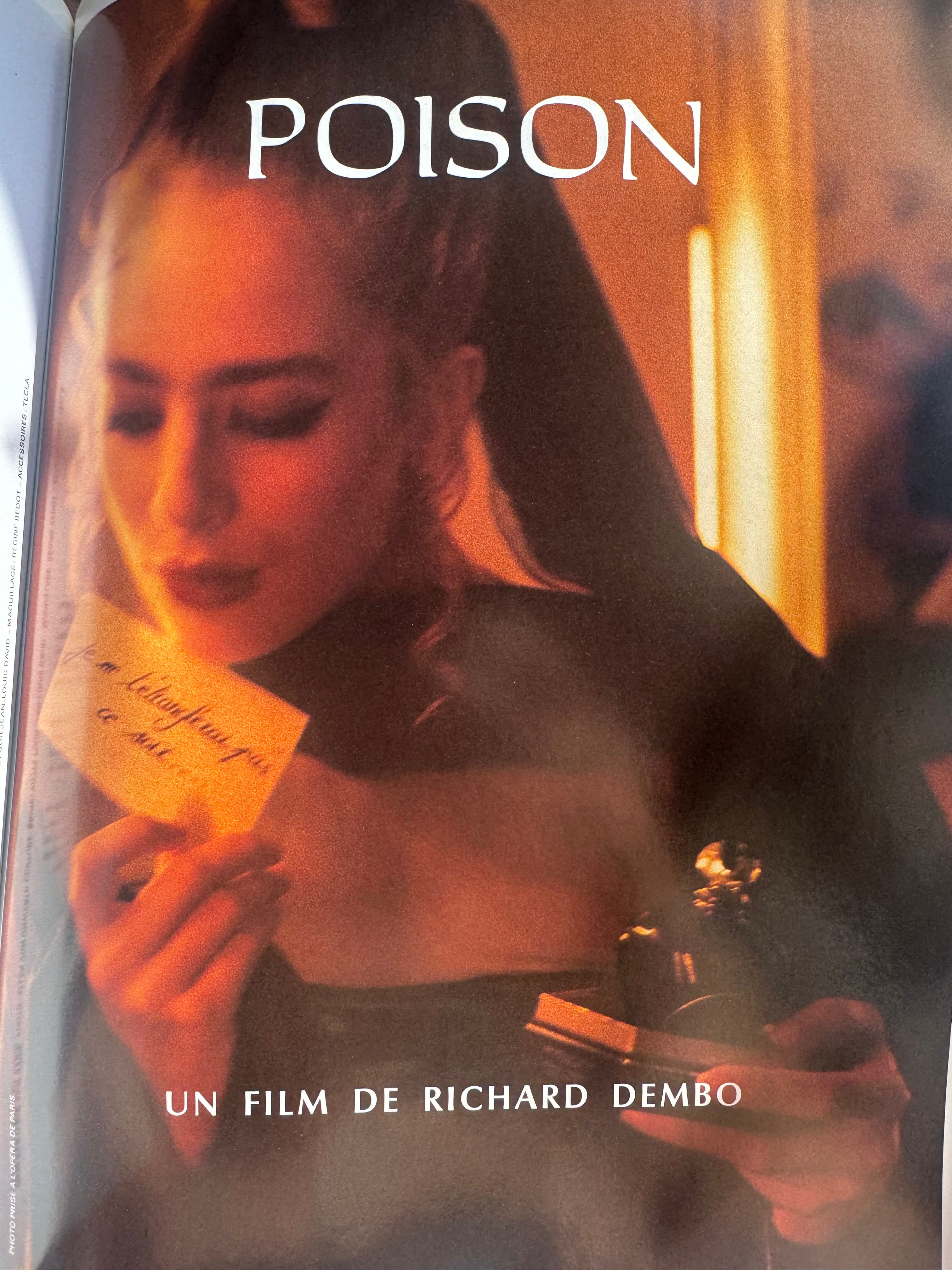
je est une autre
Bovy’s dark double [not Phoebe-Waller Bridge (soz babe)], “the reactionary feminist”, is greeted with a curt nod and a quick dismal. This spectre is represented by the lopsided trio of Christine Emba, Louise Perry and Mary Harrington. [I’m not sure Emba appreciates the association with the two denizennes of TERF island, but I’m willing to whiteknight for the two ladies (not that they need it)]. In some places, Bovy reduces the reactionary trinity to only Perry as figurehead, as in the sentence That heterosexual sex tends to better suit men than women has been observed by everyone from radical feminist Andrea Dworkin to reactionary feminist Louis Perry. (I wonder what Madame Zeus would say about that!) Bovy treats Harrington like Brahma and never deals with her directly.
Here is how Bovy describes the reactionary feminist position:
They argue that men and women are more different than the liberal, decadent sex-positive sorts would have you believe. They criticize the Sexual Revolution head-on, in a way that #MeToo did not. Rather than aimlessly gesturing at the badness of men, they point to a liberal society that let men act, unchecked, the ways they do. Perry, in particular, makes the case that the people who want to have weird sex with a million different people tend to be men, and that post–Sexual Revolution society caters to their preferences.
The sex-positive feminism the reactionary feminists argue against, the sort that treats sexual escapades as a gender-neutral social good, had already gone out of style by the time these writings appeared. In its place was this amorphous idea that the status quo was bad, but so too was all that came before. Rather than classifying relationship dynamics as ever more problematic, they label casual sex itself the culprit. Unlike #MeToo feminists, the neo-traditionalists are not afraid to victim-blame. Don’t want to be creeped upon? Find yourself a husband. (This misses that there was plenty of rape and abuse in the good old days. Maybe more of it was happening within wedlock, but it was happening.) They agree with their progressive contemporaries that the modern young woman is miserable, but suggest chastity (or reticence) followed by traditional relationships with men as the solution. The problem isn’t predatory men but the libertine culture that encourages these male tendencies. (In the three young men who are having IRL sex, that is.) Perry and Emba both insist that “consent is not enough,” by which they mean that women sometimes leave legal encounters, ones that fall short of rape, feeling used. Change the culture—and the availability of women for casual sex—and the men will exchange their date-rape tablets for briefcases, or something.
Bovy is so eager to wave away these matronly concerns to return to her preferred topic: lusting after the male-bodied guilt-free. Perry has explicitly stated that her argument for societal pressure to make sexual norms more female-coded is based on what we know about the preferences of most woman: she has not only acknowledged the existences of “straight” female outliers like Aella and Bonnie Blue (neither of whom are mentioned by Bovy), but has recorded cordial conversations with both them.
Bovy again:
The reactionary feminists are right to question the centrality of consent to sex discourse, but the problem with consent-focus is that it makes everything about the sex women don’t want to be having, rather than about the sex they do. They miss that one reason women claim to regret casual encounters is for fear of being slut-shamed, of being thought strange or desperate. The time-worn pressures on young women not to sleep around never really went anywhere, despite the arrival of a whole new set of pressures on women to do so. When a married, middle-aged woman refers to her youthful sleeping around in regretful terms, the expression revisionist history rather comes to mind.
Believe women! Unless she is middle-aged and referring to her youthful sleeping around in regretful terms… What is worse? Being called a slut or getting all-but-raped? Bovy mentions Me Too, but not Epstein (which nobody can claim nobody has been talking about) or the “grooming gangs” in England (ditto). Bovy tries to portray the concerns of the female reactionaries as schoolmarmish and passées, like Dworkin’s dungarees, even though her targets have long moved on from the gender wars, having declared victory on that front. Under the guise of a bold prediction, Perry wrote in March 2024:
[T]ransgenderism is on the way out, along with all the other manifestations of twenty-first century hyper-progressive gender politics. For good and ill.
That means that your great-grandchildren will not use they/them pronouns, and the military and police will never end up 50/50 female. It also means that the US Presidency will never be won by a woman, and in the (relatively near) future there will be many fewer women found in positions of authority in public life. If the last few decades of gender politics are remembered at all, it will be as a humorous blip. “Did you know that people in the early twenty-first century believed that women had penises?” some Stephen Fry-like figure will chuckle on a quiz show centuries from now, to the disbelief of his all-male panel.
But that doesn’t mean that wokeness per se is on the way out. Far from it.
One particular branch of wokeness that is going absolutely nowhere is the politics of racial grievance. In fact, it’s set to accelerate, particularly in some countries. Expect to see more affirmative action in higher education and more race-based quotas for government contracts. Expect to see more controversy over two-tiered policing. Expect, above all, to see more wins for politicians like George Galloway, who have cottoned onto the fact that appealing to voters’ sectarian instincts is often a successful strategy. “Free, free Palestine”? Buy buy buy!
[Since Perry has a gig producing British decline porn for the Substack arm of the Wall Street Journal one could tell her that whores in glass houses shouldn’t throw stones, but that is a cat fight for another day.]
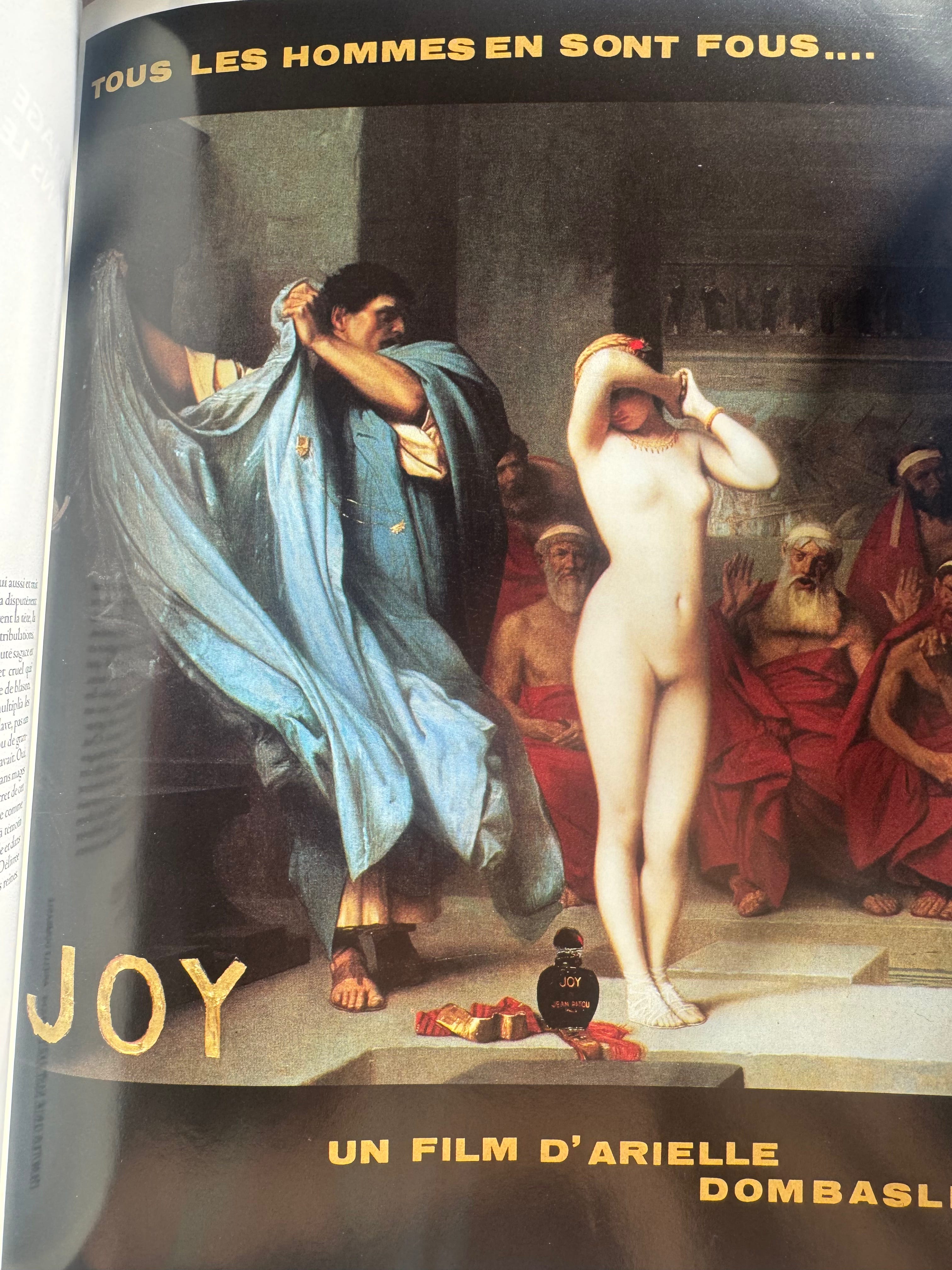
être femme, c’est littéralement impossible
I want to return to this bit, in which Bovy channels her inner Greta Gerwig [Barbie (2023) does get a mention, in fact the word “Barbie” appears 36 times in the text):
But is female desire really that different from male? If women aren’t sexual, what can explain all the efforts, across different societies, to curtail female sexuality? Why execute adulteresses or excise clitorises if not to keep us in check? (The existence of slut-shaming presupposes the existence of slut.) If sex is something women at most tolerate, what can explain the immense popularity of romance novels, which women read not as marital instruction manuals but as porn?
Note how breezily Bovy mentions executed adulteresses and excised clitorises and porn-for-woman in the same breath. As an AMAB queen, I can’t help but read this as a case of throwing everything except the kitchen sink at the imaginary intellectual opponent arguing that maybe men and women are radically different, Schopenhauer, sexual dimorphism, natural selection, mumble mumble [actually Bovy hardly considers that fact that in the eons of pre-history, “straight women” faced different evolutionary pressures than “straight men” and that it is therefore not unreasonable to expect that something like “erotic desire” might have evolved differently]. I can’t tell if this is a shoutout to the global sistahood, or whether Bovy is unaware that “executed adulteresses and excised clitorises” is not just something that one reads about in texts, but something that is actually still happening i.r.l.
Bovy writes as if the pressures on straight women are not different whether they live in Tehran or Tel Aviv, Kabul or Kansas, Mogadishu or Minneapolis. [A more honest title for the book would have been The Last Straight White Feminist]. Apart from her own, the perspectives Bovy offers mostly come from the nearest open browser tab, or a sitcom from the middle of the last century. Compare this first-person approach to the one taken by Ariel Levy in her book Female Chauvinists Pigs: Women and the Rise of Raunch Culture (2005), which is not, as the title may suggest, simply a sex-negative screed, but a careful social documetary, including original interviews, with, among others
attendees of Girls Gone Wild party where girls gladly flash their tits to whomever asks
Christie Hefner, Hugh’s daughter and at the time the chairman and CEO of Playboy Enterprises
Susan Brownmiller, who had famously clashed with H. Heffner in the 1970’s on the Dick Cassidy show
attendees of a “CAKE party”3
Erica Jong, author of Fear of Flying (1973)
Jacqui Ceballos, a former president of New York NOW
a trio of friends who share a taste for raunch: Maxim, porn, Howard Stern, Playboy, you name it.
San Francisco bois and FTMs
OK, so Dr. Bovy isn’t a journalist or a social researcher. She focuses on the “close reading” of texts, those texts just happen to be hot garbage. But why choose to focus exclusively on hot garbage? Is there some Faustian bargain that has to be signed together with a book contract. Since when? Consider the texts the (admittedly non-straight) female intellectual Susan Sontag did a close reading of in essays first published in the Partisan Review and later in collected in Against Interpretation (1961 ): “Sartre’s Saint Genet,” “The Death of Tragedy,” “Nathalie Sarraute and the Novel”, “Going to Theatre etc.”, “Notes on Camp”, “Marat/Sade/Artaud” and “On Style” [not to mention “Simone Weil”, first published in The New York Review of Books. Sontag offers to her readers, des deux sexes et d’autres, a portal, not to her personal boudoir but to other voices, other rooms.
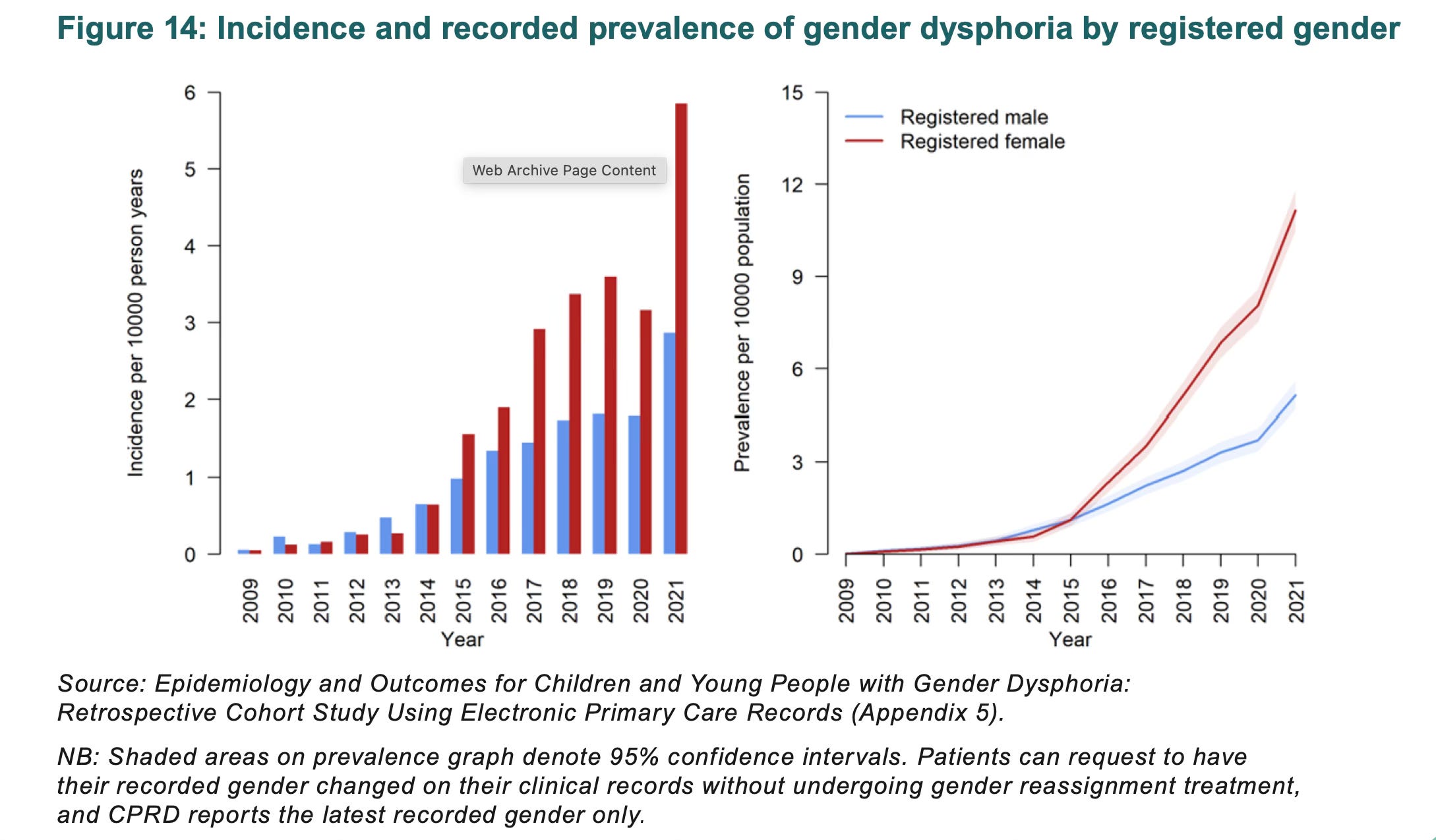
Bovy doesn't mention Levy’s book, even though the stories of the bois and FTMs are very pertinent to the whole opting-out of women thing. She also doesn’t mention Irreversible Damage: The Transgender Craze Seducing Our Daughters (2020) by Abigail Shrier, Trans: When Ideology Meets Reality (2021) by Helen Joyce or Material Girls: Why Reality Matters for Feminism (2021) by Kathleen Stock, even though two-thirds of these books were written by straight women and not nobody talked about them during the narrow period on which Bovy sets her focus. Bovy also doesn't mention the 2024 report of the UK’s Independent review of gender identity services for children and young people conducted by Dr. Hillary Cass, even though it contains the kind of graphs that can generate discourse for days:
I have never obtained a coveted Ph.D. badge, but I know enough about the norms of academia to know that it good scholarly practice to cite other work in one’s area of inquiry, especially if one wishes to refute their claims. You can’t just put all these other straight (and Heaven forbid — (faux) queer) women in a basket of deplorables labeled “radical and reactionary feminists” and ignore them. I mean, you can. These norms are obviously not enforced when one is writing for le grand public. But it’s a choice.
The “transgender critic” Andrea Long Chu does get cited as a prominent proponent of the idea that femaleness is submissiveness. Bovy isn’t having it:
While Chu is a theorist making ever so sophisticated arguments (femaleness as an abstract quality not restricted to biological women), one nevertheless arrives at the same place. The penis visits, the vagina receives visitors, fair enough. It doesn’t work to project, from this anatomical reality, a grand theory of women-are-like-so. Spend three minutes in the world of actual people, and whatever notions you may have had about a man active, woman passive division crumble. They don’t have to hold true during sex and they make no sense whatsoever in clothed settings.
I listened to Greer read her 1976 text The Female Eunuch some time after listening to Chu read her 2019 text Females4 and I realised that Chu’s “subversive” notion of “femaleness” is simply an “appropriation” of the concept of “femininity” critiqued by Greer and other paleo terfs. Too clever by half, one might say, although note that Bovy isn’t willing to say that Chu is wrong in theory, only in practice. Although I would’t be so quick to offer up the world tel quel — or recent audiovisual texts — as incontrovertible proof that “notions you may have had about a man active, woman passive division” are pure fabrication. Would that be the conclusion when presented with carefully selected three minute fragments from, to name a few recent examples, The Substance (2024) directed by (straight?) woman Coralie Fargeat, Babygirl (2024) directed by (straight?) woman Halina Reijn and “Withering Heights” directed by (married, straight?) woman Emerald Fennel (2026).
Bovy doesn’t mention Dr. Alfred Kinsey, even though the “findings” he promulgated in Sexual Behavior in the Human Male (1948) and Sexual Behavior in the Human Female (1953), that 37% of males and 13% of females had had at least one homosexual experience to orgasm, indeed bolsters her argument that the supposed greater fluidity of “female” sexuality in our own time is just as much a social construct as the greater fluidity of “male” sexuality back in the day.
are straight women boring?
This is what one might call a loaded question, so let me stick to the facts.
Arthur Schopenhauer’s infamous discussion on/of women was first published in 1951 as Chapter XXVII of Volume II of Parerga und Paralipomena (Berlin: A. W. Hayn). It was first translated into French in 1880 and into English a decade later.
In this text, Schopenhauer argues that everyone, even Rousseau, admitted that a (straight?) woman may be very cultured, but she is rarely visited by genius:
You need only look at the way in which she is formed, to see that woman is not meant to undergo great labor, whether of the mind or of the body. She pays the debt of life not by what she does, but by what she suffers; by the pains of child-bearing and care for the child, and by submission to her husband, to whom she should be a patient and cheering companion. The keenest sorrows and joys are not for her, nor is she called upon to display a great deal of strength. The current of her life should be more gentle, peaceful and trivial than man’s, without being essentially happier or unhappier.
Women are directly fitted for acting as the nurses and teachers of our early childhood by the fact that they are themselves childish, frivolous and short-sighted; in a word, they are big children all their life long—a kind of intermediate stage between the child and the full-grown man, who is man in the strict sense of the word. See how a girl will fondle a child for days together, dance with it and sing to it; and then think what a man, with the best will in the world, could do if he were put in her place.
Such obversations suggest why women have long bristled at their capacity for birth being used as an excuse for treating them as a second sex. But what is the alternative? Do we declare the war of the sexes a tie? Do let the boys and girls take turns being on top? Is being a member of a secret third gender better than being a member of the second sex? How about a fourth, a fifth? One doesn’t have to be an economist to notice the diminishing returns.
Let’s look at the numbers: here is the breakdown of the list of canonical 20th century authors compiled by a panel of literary experts on substack.com:
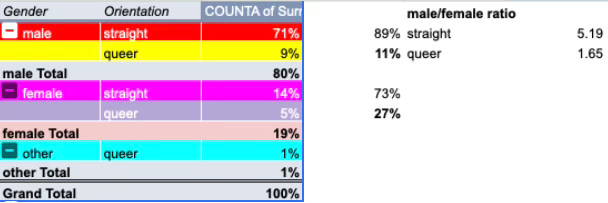
There’s no denying that Schopenhauer was a male chauvinist (out of decorum, we can leave out references to farm animals), but this does necessarily mean that he hated or feared woman or thought they had nothing to contribute to intellectual discourse:
However many disadvantages all this may involve, there is at least this to be said in its favor; that the woman lives more in the present than the man, and that, if the present is at all tolerable, she enjoys it more eagerly. This is the source of that cheerfulness which is peculiar to women, fitting her to amuse man in his hours of recreation, and, in case of need, to console him when he is borne down by the weight of his cares.
It is by no means a bad plan to consult women in matters of difficulty, as the Germans used to do in ancient times; for their way of looking at things is quite different from ours, chiefly in the fact that they like to take the shortest way to their goal, and, in general, manage to fix their eyes upon what lies before them; while we, as a rule, see far beyond it, just because it is in front of our noses. In cases like this, we need to be brought back to the right standpoint, so as to recover the near and simple view.
Then, again, women are decidedly more sober in their judgment than we are, so that they do not see more in things than is really there; whilst, if our passions are aroused, we are apt to see things in an exaggerated way, or imagine what does not exist.
The weakness of their reasoning faculty also explains why it is that women show more sympathy for the unfortunate than men do, and so treat them with more kindness and interest; and why it is that, on the contrary, they are inferior to men in point of justice, and less honorable and conscientious. For it is just because their reasoning power is weak that present circumstances have such a hold over them, and those concrete things, which lie directly before their eyes, exercise a power which is seldom counteracted to any extent by abstract principles of thought, by fixed rules of conduct, firm resolutions, or, in general, by consideration for the past and the future, or regard for what is absent and remote. Accordingly, they possess the first and main elements that go to make a virtuous character, but they are deficient in those secondary qualities which are often a necessary instrument in the formation of it.
Does this offend you, ladies? Learn to take it like a man.
“gay” “male” “history”
Bovy doesn’t appear to be threatened by Chu’s appropriation of femaleness, since as a 100% straight woman she identifies as FnH (Frumpy ‘n Horny), i.e. she has little love to to spare for herself as a woman. She seems more affronted on behalf of gay men by the spectre of a “straight woman” larping as a “gay man”, with a surprisingly sceptical read of “Harry Nicholas’s 2023 memoir A Trans Man Walks into a Gay A Bar”:
By transitioning, Nicholas gains access to a type of man-liking and man-pursuing that is simply not available to women. He visits gay bars and saunas, finds more men on apps than he knows what to do with, and makes repeated reference to how freeing it is to be queer and thus not part of the heteronormative constraints that lead people to settle down with a partner. He has nevertheless, by the book’s end, settled down with another man.
Nicholas writes in strangely confident tones about things he believes straight people are incapable of noticing: the rainbow flags on a gay bar, or the longing look of a man in a David Hockney painting. For Nicholas, being a gay man, rather than a straight woman, means more than just getting to live as the man he knows himself to be while having the male partners he desires. It’s also membership in an in-group. It’s access to a sensibility.
Is someone with a vagina arriving at a gay male space—or in a gay man’s bed—a transgender pioneer, or are they disrespecting gay men? Opinions evidently differ. When Nicholas uses “we” and “our” to speak of gay male history, there is a part of me that questions whether he really ought to be including himself in the history of—how else to put this?—men into dick. But I’m a cishet woman, right? So I’m not meant to question such things. But you know who has questioned them? Some cis gay men.
Nicholas is no bachelorette. He nevertheless writes about the backlash he’s experienced from within the gay male community. “As a publicly out trans gay man I have been labelled a ‘sex tourist,’ accused of ‘committing rape by deception’ and told that I am appropriating gay culture.” He rejects this interpretation. But at the end of the day, this is less about his persuasiveness than his lived experience. He writes about falling into the trap of having too much casual sex…with men, via Grindr. I can sit here saying that a gay man should have every right to demand that his partners have penises, but if some gay men themselves aren’t bothered (he writes that some are, some aren’t; Becker, the detransitioner, evidently had no trouble finding men on these same apps), who am I to say they should be?
Bovy is intent on staying her lane, even though some of her best friends are gay/queer. I’ve long criticised the homoreactionary claim to “gay and lesbian” as opposed to “queer” “spaces”. Nevermind the dolls, do we still have to talk about bi (in)visibility in 2026? Apparently so.
Many moons ago, I wrote (under the thin veneer of a fictional persona:
The problem with Queer Theory is not that it is queer but that it is theory.
The solution is not a more jealously guarded academic Bantustan.
In every society, the clerical caste needs to prove itself useful (or at least not actively harmful) to the economically productive population. American academics are clearly failing at this task. It’s a much bigger problem than a lack of respect towards cis white gays.
Fortunately, the academy is not the only way to maintain cultural traditions and much of gay culture is not Yanigihara or Hearstopper. I am no fan of Yanigihara-style gay trauma porn, but plenty of gays are. Luckily, there are many more choices on offer in the gay cultural buffet: RuPaul, Troye Sivan, Kim Petras, Dua Lipa, Mike White, Jennifer Coolridge, John Cameron Mitchell, Pedro Almodóvar, Tom Ford, Alexander McQueen, Celine Dion, Madonna, Cher, Elton John, Judy Garland, James Baldwin, Jean Genet, Oscar Wilde, Marcel Proust, Rimbaud, Michaelango and Plato, to name but a few. Not all of these artists are gay and neither is all of their art, but they all inspire millions of actually existing gays — what else is a culture for? And as far as I know, none of them were the products of a Gay Studies department. We don’t need more Bergmans to write about Holleran and Kramer, we need more Hollerans and Kramers!
I have my differences with the gay contributors to the gay symposium Inversion: Gay Life after the Homosexual (2025), but at least the co-host Pierre d'Alancaisez/Verdurin has the tzedakah to acknowledge the cumdump in the room. Allow me to indulge in another self-citation:
It is also not obvious to me why we should analogise gay history to the history of the English or the Poles rather than to the history of tarot or opera.
I believe that there are certain social constructs like “citizen” and “debtor” that should, for the time being, be treated as necessary evils. I believe there are other social constructs such as “straight”, “gay” and “queer” that should be treated like mind-forg'd manacles to be melted down and turned into something more beautiful (un veau d'or, peut-être?)

keeping the gate after the gay horse has bolted
Bovy writes:
If you’re a young woman who likes men, but whose interest in sex is perhaps less than your boyfriend’s, you could cop to fulfilling a stereotype about women having lower libidos than men. Or you could do something more modern and situate yourself on the asexuality spectrum. You can call yourself a “demisexual”—a type of asexual—and have people anxiously googling what you are, lest they offend a marginalized minority, only to learn that demisexuals are people who only have sex once they’ve formed an emotional bond. Conversely, if you’re a promiscuous woman whose many partners are all men, you can climb under the queer umbrella via self-identification as kinky, polyamorous, or even hypersexual.
I’ve expressed similar annoyance at the queer larpers, but on reflection, if we expect everyone to devote an entire calendar month each year to express just how proud they are of us, it would be rather churlish to check the papers of those who identify with gay history. There is no reason why someone from Nigeria cannot develop a passion for Anglo-Saxon history. Why should the “kinky” be put in a different category from the “gay”, what does any of this have to do with equality before the law?

you don’t have to read my lowercase rantings, but i do recommend giving attention to the portraits of queer africans in that post.
après moi, le fascisme
Levy writes:
In an interview with ABC’s 20/20, Kramer and Gallagher said that they chose “cake” as their name because it is a slang term for female genitalia, and connotes something “gooey, sweet, yummy, sexy, sticky.”) They have 35,000 online subscribers, a book deal, a Web boutique through which they sell tank tops and vibrators, and a Showtime reality pilot in the works. CAKE is also a sort of hypersexual sorority. You have to pledge to get in, which involves writing an essay and paying a hundred dollars. Then, if you are accepted, you get regular e-mails from CAKE’s founders called “CAKE Bytes,” on everything from the Bush Administration’s war of attrition on abortion rights to the perceived weaknesses of Sex and the City. Kramer and Gallagher engage in a certain amount of old-school grassroots organizing—they arranged for a bus to take women from Manhattan to Washington, D.C., for the April 25, 2004, March for Women’s Lives, for example—but their parties are what have put them on the map. Themes have ranged from “Striptease-a-thons” to porn parties, and the events are thrown at upscale venues like the W hotels and velvet-rope clubs throughout Manhattan and London. CAKE made the front page of the New York Post with one of their early parties in 2001, at which two guests, the adult film actors Marie Silva and Jack Bravo, had intercourse and oral sex inside CAKE’s designated “Freak Box,” a steel closet with a camera inside offering everyone outside live streaming video of the shagging-in-action projected onto huge screens throughout the party.
See my forthcoming book: Memoirs of an ambulant reactionary gay dog dad
You know, I think the main reason I wasn’t super interested in this book is that I expect it says a lot of things that I have already thought about and agree with. Reading your response makes me think I was correct about this. You can count me among the many women whose lifetime sexuality falls quite normally in between Louise Perry’s fussy “oh noooo, don’t have sex with someone you wouldn’t commit to, your poor heart, you’ll be so damagedddd” and Aella’s lurid “I would like a gangbang for my birthday.” The middle ground is wide and boring.
PMB is not wrong that being straight is a tad uncool with some of the young folks. My youngest sister and I had a conversation a few years ago where she mentioned being bi, and I said I was only mostly straight, and she said “yeah, women are just so pretty” and I said “nah, men are prettier, if you ask me,” and she looked at me like I had made a bit of a faux pas. I wasn’t following the script!
The thing is, both I and PMB are from a generation of internet feminists for whom overt desire for men really was seen as rebellious, as pushing back on a sexist society. Female heterosexuality is superficially normative, but when it is active rather than passive it violates an implicit rule that only women can be desired sexually and only men can do the desiring. We felt—I felt—like I was building my own straightness out of scattered parts: gay, straight, male, female, find the bits that resonate and make something authentic.
But of course it’s normal to grow old and uncool. I’m a monogamous straight-married woman in her early forties. I resigned myself long ago to being (outwardly) boring in my sexuality. It’s fine.
Louise Perry’s simpering remark to Ross Douthat about needing to learn to love the differences between the sexes by getting married did make me want to puke a little bit. If that kind of “my spouse is an avatar of Gender” was the only kind of straightness on offer then I, too, might be trying to borrow a little more queerness. But marriage, for me, feels more like an escape from all the genderslop nonsense. I am not married to Man. I am married to a person, who happens to be a man, which is nice, because I tend to like that sort of thing. And yes, I think he’s very pretty.