
Read Wright
Two Cultures, One Future

When I was still reading e-publications like Jacobin.com a decade or so ago, they ran articles arguing that the cybernetic experiments by Allende’s government, put to an end by Pinochet (advised by Friedman, of coursed demonstrated that one day Hayek’s criticisms of central planning would be obsolete. With enough data and processing power we can accelerate our progress not on the road not to serfdom, but on the road to equitable prosperity: Fully Automated Luxury Communism, as the 2019 manifesto of the British leftist Aaron Bastani was memorable called. Sophie Lewis, author of Full Surrogacy Now (2019), declared confidently that she would rather die than work.
Now that the technology is here to free humanity from toil and scarcity, are leftist intellectuals heralding our brave new world?
Ha ha! Ha ha!
Our culture’s bipolar response to our most impressive creation (it will either cure all disease or kill us all)1 can partly be explained by the mutual distrust between scientific and literary intellectuals observed by C.P. Snow in his 1959 Rede Lecture, “The Two Cultures and the Scientific Revolution”:
The non-scientists have a rooted impression that the scientists are shallowly optimistic, unaware of man’s condition. On the other hand, the scientists believe that the literary intellectuals are totally lacking in foresight, peculiarly unconcerned with their brother men, in a deep sense anti-intellectual, anxious to restrict both art and thought to the existential moment.
Snow goes on the observe that literary intellectuals are “natural luddites”:
The academics had nothing to do with the industrial revolution; as Corrie, the old Master of Jesus, said about trains running into Cambridge on Sunday, ‘It is equally displeasing to God and to myself. So far as there was any thinking in nine-teenth-century industry, it was left to cranks and clever workmen. American social historians have told me that much the same was true of the U.S. The industrial revolution, which began developing in New England fifty years or so later than ours, apparently received very little educated talent, either then or later in the nineteenth century. It had to make do with the guidance handymen could give it-sometimes, of course, handymen like Henry Ford, with a dash of genius
Faced with the obsolescence of human knowledge, many humanists seem to be choosing denial or panic. To help set all the hype and doom-mongering into perspective, there are few writers more capable than Robert Wright: a scientifically minded Buddhist*-inspired writer and broadcaster who is unafraid to tackle thorny political issues without overpoliticising them.2 In The God Test: AI and Our Coming Cosmic Reckonimg (2026), he offers an admirably succinct and lively explanation of what makes LLM so revolutionary: they developed the ability to think in a way that is analogous to how organic life developed the ability to think, through trial, selection and evolution. This analogy suggests that AI isn’t about to hit a wall. It will continue to develop in ways that will increasingly difficult for us to control.
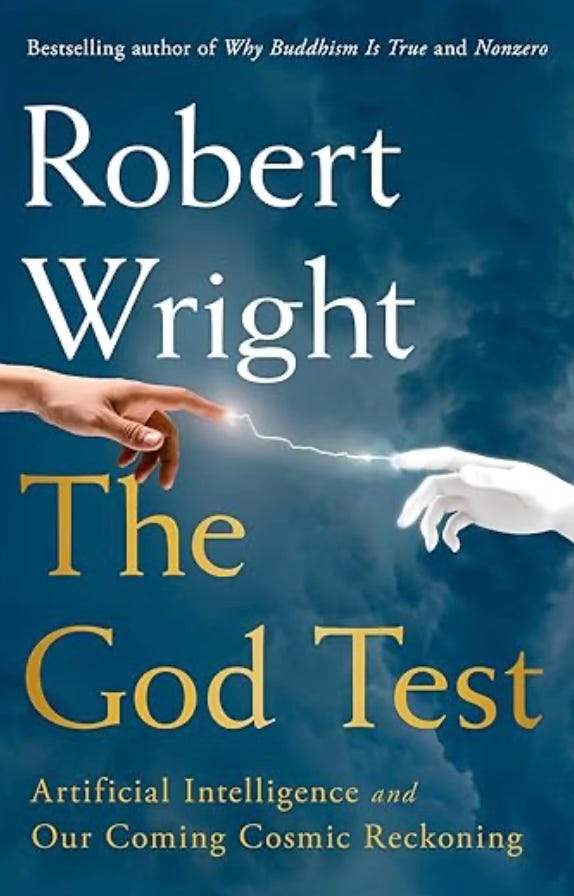
If you don’t want to read the whole book, I can recommend a recent episode of Wright’s Non-Zero Podcast with Connor Leahy on “The Ideology Behind AI.3 I don’t know how helpful it is to dwell on the motives and weird sex lives of those summoning the machine gods/demons, except to realise that expecting these people to “self-regulate” in a way that avoids catastrophe is naive to the point of culpable negligence. The question is not should “we” regulate AI, but how (also who’s “we”?) There is no big red “Regulate AI!” button that the evil Republicans are unwilling to push, but can be pushed if “our guy” gets into office.
Let’s compare our current situation to the last time there was a bit of a wobble in public trust in the wisdom of the titans of industry. In response to the 2007/8 financial crisis, banks have been told to get their books in order and to take fewer risks, in exchange for easy profits from low interest rates. Most of the fun has gone out of Big Finance. Yes, the bankers are still filthy rich, but not through black magic. There is a lot of money that needs to go around to keep the global economy going and to a first approximation bankers simply keep a sliver of these funds in exchange for facilitating these movements. The market-to-book ratio of Goldman Sachs and JP Morgan Chase is a rather conservative 2.5. Things look very different on the West Coast. Microsoft’s market-to-book ratio is 10, i.e. for every dollar of assets certified by the public accountants, there is nine dollars of intangible value implied by the market’s valuation. Apple’s ratio is 50. Market participants clearly believe that the gains from AI will be substantial — and substantially privatised. This doesn’t strike me as a politically tenable situation — unless the whole world becomes China, which it might. What is to be done? Nationalise Apple? And then what?
Leahy grasps Nick Land’s simple message that Marx + AI = Hoorrah for Human Extinction! If value is defined in terms of human labour, and capital can create practically limitless copies of human labour, the value of human labour becomes zero. That means the bargaining power of labour, organised or unorganised, becomes zero. The system will have no need for humans, so it will continue without us. If we let it.
I don’t know if a nightmare scenario can be avoided. But I know it won’t be avoided if we don’t get our heads out of the sand. Start by reading Wright.
Of course, it could first cure all desease and then kill us.
I include the asterisk is a nod to the annoying discourse a while back about whether a psychologised Buddhist philosophy compatible with modern science, the kind promulgated by Wright in his 2017 book Why Buddhism is True, counts as true Buddhism. Exempli gratia, friend of the blog and dearly departed (from Substack) Becca Rothfeld in All Things Are Too Small: Essays in Praise of Excess (2024):
It is a fool’s errand to divvy up cultural terrain into precise parcels, and there are many points of overlap between traditional forms of Buddhism and their modernist descendants. Nonetheless, there are a number of recognizable if never fully rigid differences between the two tendencies. Broadly speaking, modernist Buddhism involves what McMahan has termed “demythologization,” the recasting of myths that are taken literally by many traditional Buddhists as metaphorical and the attendant softening of cosmological commitments. Demythologization absolved Western acolytes of charges of polytheism, allowing them to claim that the many gods in the Tibetan and Himalayan pantheons are only symbols for conflicting facets of the mind. Modernist Buddhism was “granted...entry into the modern West, whose monotheism and modernity could not abide a gaggle of gods inhabiting the real world,” only because it exiled its deities “from the world of molecules and atoms” and relegated them “to the psyche.” Attempts to translate mythology into proto-Freudian terms sat comfortably with the modernist reconceptualization of “Buddhism as psychology.” Beginning in the early twentieth century, New Thought adherents began to describe the tradition as a “science of mind,” a characterization that would later find favor among psychoanalysts and has since made its way into the flurry of best-selling mindfulness books with rationalist pretensions.
It is not obvious to me that the literal worship of the “Tibetan and Himalayan pantheons” should be considered the “traditional” form of Buddhism with any more iconoclastic varieties being Western impositions. Gautama himself was from the ksathriya caste, but most of his most important followers Brahmins. I don’t want to over-analogise between Prots/Caths and Buddhists/Brahmins, but I think it is a comparison worth reflecting on, especially as “caste consciousness” seems to becoming more of a thing.
In The God Test, Wright invokes the experience of selflessness he had on a meditation retreat as proof of a sort that is difficult yet not impossible for humans to look beyond our own selfish desires and fears towards a more objective view of what is good for all of us, moving from zero-sum to non-zero-sum interactions. I was reminded of the criticisms of Husserl by a Zen thinker, Katsuki Sekida, quoted by Murdoch in Metaphysics as a Guide to Morals:
The idea of suspending every involvement of the personal ego agrees closely with our view of the need to eliminate the habitual way of consciousness. However, the methods advocated for doing this are utterly diferent. In zazen [the Zen discipline of sitting in meditation] we effect it not by a simple change of mental attitude, but by hard discipline of body and mind, going through absolute samadhi [state of deep meditation], in which time, space and delusive thoughts fall away.
Murdoch writes
Sekida takes Husserl seriously in a way in which, for instance, Adorno does not and Wittgenstein would not. The idea of pure consciousness’ or ‘pure cognition’ makes sense for Sekida, but not as something to be attained or used by Husserl’s, as it would seem to him naive, method. Sekida questions Husserl’s assumption that there is a pure cogitatio which can be reached by ‘setting the ego aside’ in an act of philosophical reflection available to anybody who can do philosophy. The egoistic (personal) formulation and distortion of reality reaches right down to the base of unenlightened cognition, and one cannot by a reflective move cancel it and obtain some ‘purified intro-spectible mental datum’. There is no such thing, discoverable by philosophers who may be clever but not necessarily (in a moral or spiritual sense) selfless or wise, which could be set up as an eidos or essence to become part of a general profound ‘science’ of the human world. There can be no such science.
I will also repeat my recommendation of God, Human, Animal, Machine: Technology, Metaphor and the Search for Meaning (2021) by Meghan O’Gieblyn).
It sort of sounds like you're in furious agreement with Marx, if I follow this correctly? Not, of course, in agreement with all his self-declared followers.
I just read The Philosopher's Pupil, which I liked a lot. Interesting for thinking about how Murdoch thinks about the novel / philosophy relationship.